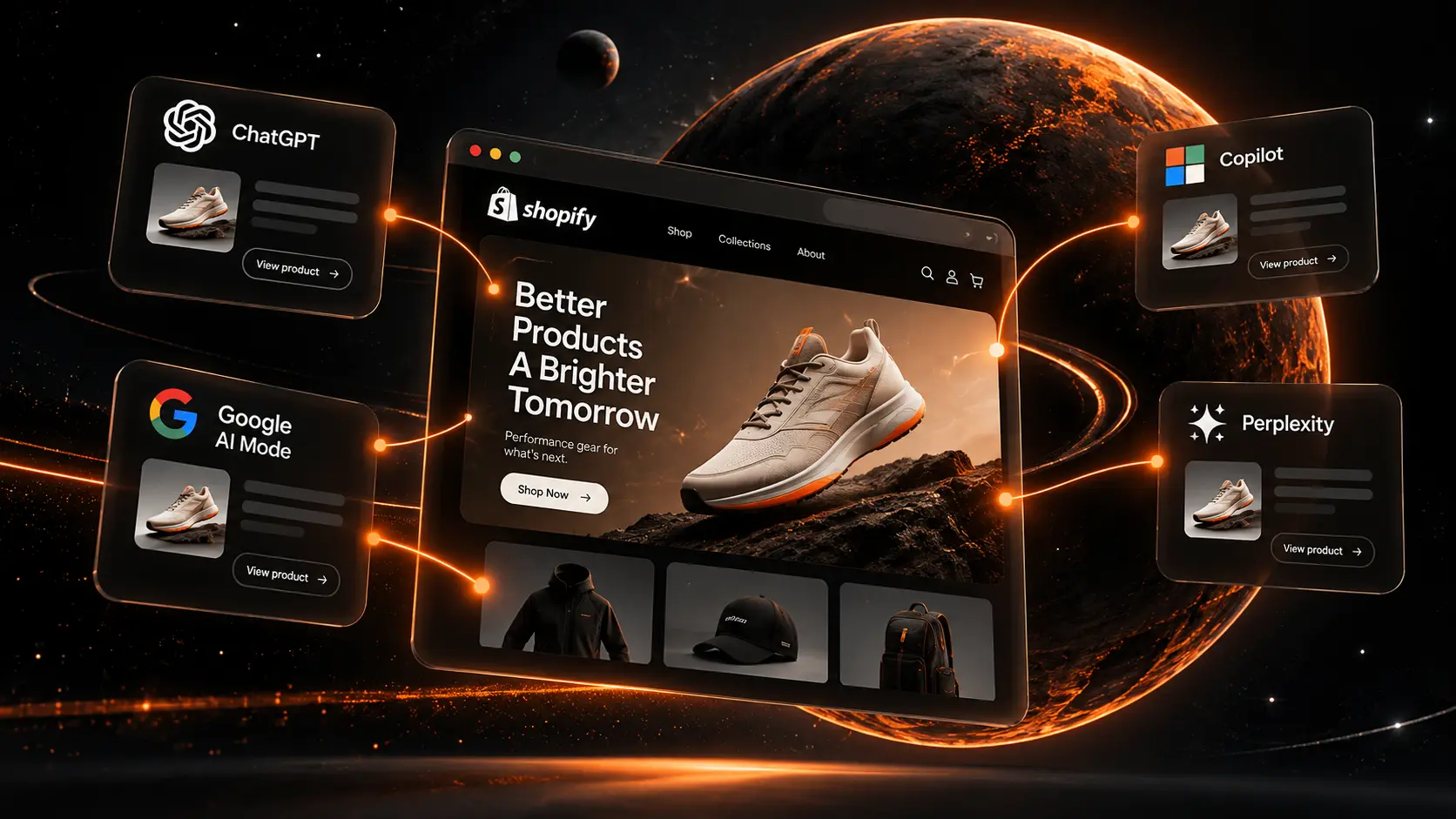
AI is becoming a new storefront. Here’s what Shopify merchants should change now to stay visible as product discovery moves beyond traditional search.
AI is becoming part of the buying journey
AI shopping is no longer just a different way to search. A shopper can describe what they need, compare options, narrow the choice and arrive at a specific product without visiting a homepage or collection first. That changes where discovery happens and what information has to do the selling.
Shopify’s Q1 2026 commerce data shows the channel is still smaller than organic search, but it is growing quickly. Referral sessions from AI chatbots grew more than eight times year over year, while AI-referred orders grew nearly thirteen times. Organic search still sends substantially more traffic, so this is an additional channel to prepare for, not a reason to abandon SEO.
The traffic is smaller. The intent is stronger.
The more interesting signal is what happens after the click. Shopify reports that more than half of AI-referred sessions begin on a product detail page, compared with about 20% of organic-search sessions. On comparable product-page sessions, AI-referred visitors converted at nearly 50% higher rates, and orders attributed to AI-powered search carried 14% higher average order values.
That makes sense. In a traditional search journey, research is spread across queries, category pages, reviews and multiple sites. An AI assistant can compress much of that consideration into one conversation. When the shopper finally reaches the store, they may already know the product, price range and features they want.
Your product page may become the new homepage
If AI sends a shopper directly to a PDP, that page has to work without the context normally supplied by the homepage. The product title, description, imagery, variants, specifications, sizing, compatibility, shipping information, returns and trust signals need to answer the questions that matter before purchase.
This is where good ecommerce architecture and AI discoverability overlap. Clear HTML, descriptive product copy and complete attributes help machines understand the product, but they also reduce uncertainty for the human who lands there ready to buy.
- Use specific product titles instead of internal naming that only your team understands.
- Write descriptions around real attributes, use cases and differentiators, not filler copy.
- Keep variant names, pricing, availability and product taxonomy accurate.
- Put important buying information in accessible page content instead of hiding it inside images or heavy client-side interactions.
- Treat mobile PDP performance as part of conversion, because a qualified click is wasted if the page feels slow or unstable.
Shopify is building infrastructure for AI-native commerce
Shopify’s approach goes beyond referral traffic. Agentic Storefronts lets eligible merchants manage distribution to AI surfaces from Shopify Admin, including ChatGPT and Microsoft Copilot, while Google AI Mode and Gemini support is rolling out through Shopify’s ecosystem. Shopify Catalog acts as a structured product-data layer, keeping information such as pricing, attributes and availability usable across connected AI experiences.
Underneath that is the Universal Commerce Protocol, an open standard co-developed by Shopify and Google for agent-to-merchant commerce. In Spring ’26, Shopify also opened its Catalog API and agentic commerce tooling more broadly to developers. The direction is clear: product discovery can happen outside the storefront, while Shopify continues to handle the commerce infrastructure behind the transaction.
What we would change on a Shopify store now
There is no reason to rebuild a healthy store around an unproven ‘AI SEO’ checklist. The highest-value work is mostly the same work that makes a storefront easier to crawl, understand and buy from. The difference is that product data and PDP quality now matter to another discovery layer as well.
- Measure AI referrals separately in Shopify Analytics before deciding how important the channel is for your store.
- Audit the products that matter most: titles, descriptions, attributes, variants, inventory and structured data should agree with each other.
- Make PDPs self-contained enough for shoppers who never saw your homepage or collection page.
- Strengthen authority outside your own domain through legitimate reviews, editorial mentions, comparisons and community discussion.
- Keep technical SEO healthy. Organic search remains the larger channel and many AI experiences still rely on web indexes and crawlable content.
- Avoid adding apps or scripts simply because they promise ‘AI optimization.’ Fix the underlying information and storefront quality first.
The opportunity is not to chase AI. It is to become easier to recommend.
The useful takeaway from Shopify’s early data is not that every store needs a new AI strategy overnight. It is that product discovery is expanding beyond the classic search-results page, and the buyers arriving from those experiences can be unusually qualified.
Brands that are technically clean, explicit about what they sell and trusted across the web are well positioned whether the recommendation comes from Google, ChatGPT, Gemini, Copilot or a channel that has not launched yet. Build the product information and buying experience so both people and machines can understand it. The distribution layer can change without forcing the storefront to start over.
AI discovery is a distribution change, not a replacement for good ecommerce fundamentals. Make the store fast, the product data precise and the buying decision easy. Those improvements compound across search, AI and direct traffic.